

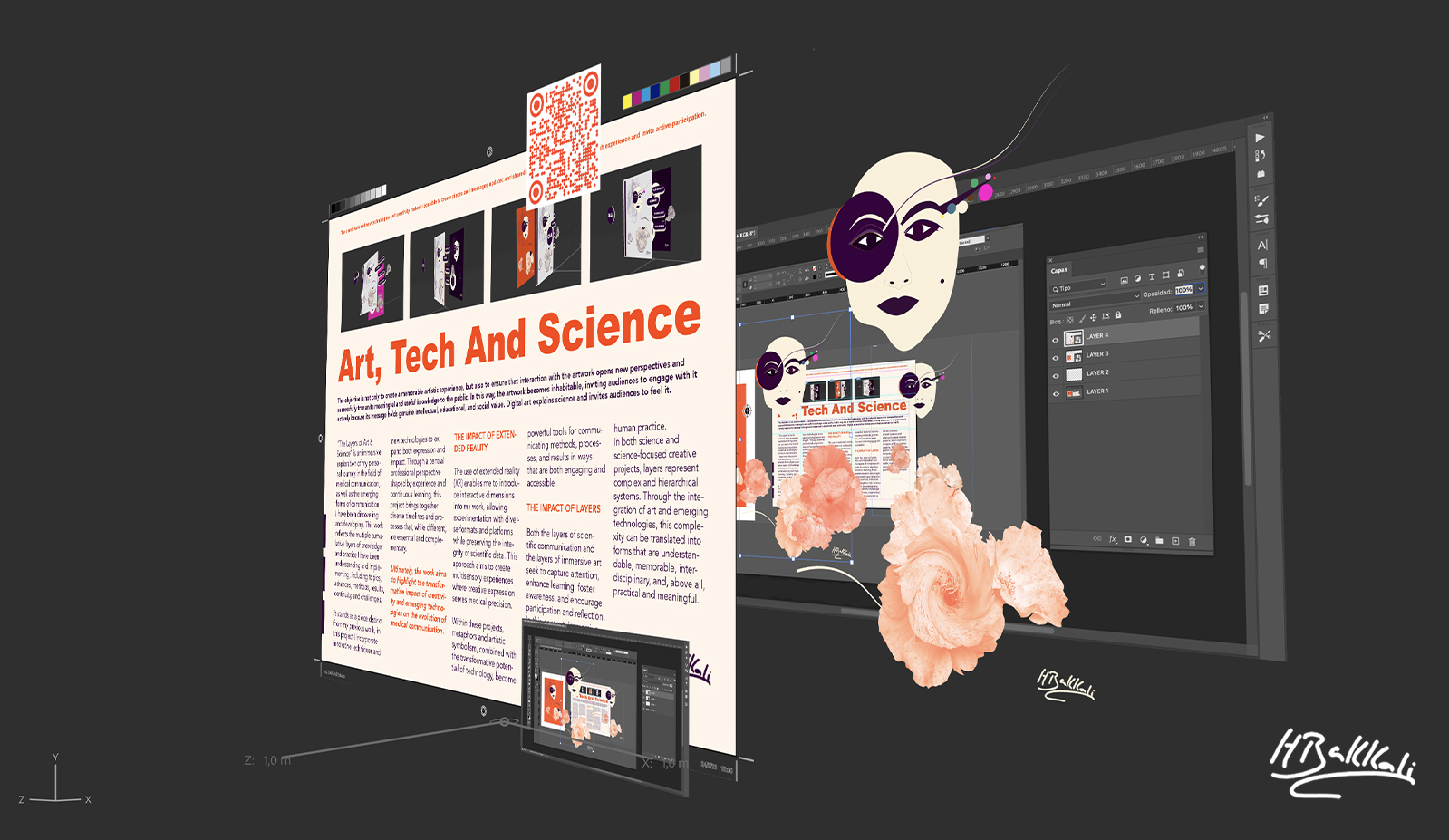
New technologies broaden the spectrum of tools, environments and platforms for the communication and dissemination of science and medical knowledge.
New technologies range from infographics to interactive tools, from audiovisual resources to immersive spaces, from augmented reality to virtual reality. The advancement of technology makes it possible to adapt the medical and scientific message, prioritize it and structure and adapted it for each space and for each audience. Every day, technological tools increasingly empowers creatives. New spaces and new environments where the concept finds all the necessary resources to reach the public with greater impact, inviting greater participation and also with the ambition of fostering better understanding.
Creativity: Center of Attraction
Art in this context is the interface of knowledge, but it is a dynamic, sound-based, audiovisual, interactive interface with the capacity to change and evolve over time. Creativity is not confined either within a physical frame or encapsulated in a sealed digital space. Our center of attraction becomes more fluid and manageable. Technology gives us the possibility to reinvent it according to the moment, the objective and the audience.
In the field of medical and scientific communication and dissemination this acquires a special meaning: versatility, adaptability. It allows us to work by providing usefulness: conveying medical-scientific content in a clear, understandable and accessible way.
Las nuevas tecnologías amplían el espectro de las herramientas, contenedores y plataformas para la comunicación y divulgación de la ciencia y del conocimiento médico.
De las infografías, a los interactivos, de los recursos audiovisuales a los espacios inmersivos, de la realidad aumentada a la realidad virtual. El avance de la tecnología permite adaptar el mensaje médico y científico, esencialmente, jerarquizarlo y estructurarlo de la manera más optima y adaptada para cada espacio y para cada público. Cada día, la practicidad de las herramientas tecnológicas empoderan más a los creativos. Nuevos espacios y nuevos contenedores donde el concepto encuentra todos los recursos necesarios para llegar al público con mayor impacto, invitando a una mayor participación y también con la ambición de fomentar una mejor compresión.
Technology: Center of Activation
Although technology in the field of science and medicine may occupy a central position, whether due to trends, agendas, slogans or necessity, there still seem to be challenges ahead for the normalization of its practical use —not only experimental or theoretical— in everyday life. Although it is true that one cannot generalize and that each context presents its own particularities, we can speak of several needs, such as improving digital culture and literacy, the need for ideas for real and continuous practical implementation in the medical-scientific context, risk of obsolescence, costs in continuous training processes and in equipment and tools that require constant updating, highly specialized multidisciplinary professional teams with the capacity to adapt to change, monitoring and updating, or the impact and absorption of AI competencies, which are just some of the limitations that may delay, question or restrict the complete and sustained application of technologies in this field.
But the reality is that in the field of medical and scientific communication the potential of the combination of art and new technologies is unquestionable. Although the demands remain the same, the power acquired by the artist when adding their work to platforms and technologies that are accessible and easily understood by users reverses the hierarchy. Technology, instead of posing limitations, begins to function as an essential and even friendly ally for the activation of the work and, therefore, for the dissemination of medical and scientific knowledge.
Today, those of us who work in this field are aware that we operate in a space that essentially requires observing very carefully and acting with great rigor. Producing with real impact and usefulness translates into designing projects with a method and a clear roadmap. It demands great rigor. Knowing what we want and why we want it. Then grounding how and with what to execute it. Finally measuring the results and analyzing the reach. And starting all over again.
Science: Center of Legitimization
Perhaps this is one of the most difficult and at the same time easiest points to address. Although it is logical to think that content must prevail over the container. Although science must be treated with rigor and responsibility. Although addressing medical content implies an unquestionable ethical and professional commitment. Technology and art, when combined with the words science and medicine, can trigger every alarm, since on many occasions this fusion is instrumentalized to frame it within an event, a photo, an agenda or a slogan that creates impact and that runs the risk of quickly being forgotten or remaining latent without evident social usefulness, reduced to an experimental investment. This fact may be precisely the element that causes trust in technology to be lost, that trivializes the use of art in the dissemination of medicine or that ends up using science as leverage for a narrative that does not always provide scientific value. The public usually has an extraordinary capacity to observe, understand and measure over time. The public has memory. And if the campaign does not translate into real and lasting usefulness, valuing the sensitivity of the receiver and understanding the mechanisms of science, it usually remains a magnificent staging, but archived.
We are participants, many of us have the enormous luxury of being protagonists, of a stage of extraordinary challenges and even more extraordinary opportunities. When we have that ability to create, to communicate and to be part of the construction of new spaces as delicate and as important as science and medicine, anticipation is very important, but above all so are deep knowledge, responsibility beyond the headline and the ability to create beyond experimenting.
Science legitimizes us when we are able to absorb it through its own models, expanding it beyond content and meaning. Structuring the framework according to the needs of the receiver. Investing in sensitivity, dissemination and aesthetics, of course. But, above all, in a sense of usefulness and global, universal participation. Perhaps a primary and unquestionable duty whose need acquires a much greater scale and demand when we talk about approaching health and medicine through the combination of art and technology.
The Artist: Center of Expansion
The work of the artist moves from being merely decorative to bringing emotion to the message and strategy to the structure. To conquer through the creative concept and also through the ability to communicate through visual, interactive, multimedia and immersive language. A context that presents exceptional challenges:
- The challenge of continuous and deep training and learning. Technology has the particularity of flying at an almost unreachable speed; the challenge of being permanently alert to what is new, what is discontinued and what may become discontinued is as impossible to assume as it is essential.
- The challenge of obsolescence. Technology transforms, sometimes disappears. Here the challenge of responsibility when approaching any project, but even more so a medical project, is indisputable.
- The challenge of comfort and quick solutions. The use of technologies and the increasing ease of access and learning can drag us into a dangerous comfort zone in which creatives delegate skills to technology and the medium without controlling in detail its language, dynamics, context or communities. Whether working with external platforms or creating our own tools and platforms, it is our responsibility to understand the tool and its environment in detail, making responsible use of it.
- The challenge of the concept, seen as the central core. Without ideas there is no project. Technology is an enabler and creatives should set its pace.
- The challenge of communication. In this space of creation, when technology is the engine, art the interface, content the foundation, we creatives adopt a demanding role in times of maximum digital dynamization, of changes, noise and slogans not unrelated to the instrumentalization of science and medicine, to the use of technology as a trend and to art understood as a purely aesthetic framework. Talking about art, technology and medicine requires training and decision-making, but essentially awareness. Sensitivity when approaching medical topics. Ethical criteria in the use of language and technology. Assessing the impact of each project, considering its usefulness and assuming the risk of short-term works versus the benefits of evolutionary projects that use art and technology with the same rigor with which they approach the content that defines them. And here the most important challenge is time: adaptation of resources, training of the receiving audience and specialized teams. Considering the use of the agenda set by short-lived trends versus competing in the very difficult space of approaching usefulness and permanence.
In this challenge of communication, it is no longer only our work and our creative vision that speak. Our tools also communicate, as do the practicality and usability of the technologies we have chosen and our ability to generate connection and participation around our projects.
As I have been able to share in many of my meetings through the Alliance Française in different countries, faced with these challenges, each more demanding than the last, technology offers us freedom: to observe, learn, select, create, disseminate, measure and start again. To create with perspective, reducing dependency and with the ability to expand our works globally and transversally. Breaking the habit of pigeonholing and moving away from the fear of being pigeonholed, taking the work out of its frame and turning it into an asset capable of flying on its own through multiple spaces and platforms, sharing emotion and content, creative vision and scientific ambition beyond spatial, generational and temporal limits. With measurable communicative impact, observable social value and real applied usefulness. A work of art designed to communicate, allowing us to immerse ourselves in medical and scientific knowledge in a thousand different ways. A work that is always alive and in continuous expansion.